
Can You Epoxy Over Tile or Vinyl Flooring?
If you're planning to update an old basement, laundry room, utility space, garage entry, or commercial floor, you may be wondering whether epoxy can be installed directly over existing tile or vinyl flooring.
We hear this question often from homeowners throughout Northeast Ohio who are researching interior epoxy flooring, basement floor coatings, and other concrete coating options. It is easy to understand why. Removing old flooring can be messy, disruptive, and more involved than people expect.
The short answer is that epoxy can sometimes be applied over certain existing surfaces, but it is not always the best choice. The condition of the tile or vinyl, the adhesive underneath, moisture conditions, and the floor’s intended use all matter.
Let's take a closer look at when epoxy over tile or vinyl makes sense, when removal is the better option, and why a professional evaluation is so important before moving forward.
Why homeowners want to epoxy over existing flooring
Most homeowners ask about coating over tile or vinyl because they want to avoid demolition.
Old flooring removal can create dust, add labor, and sometimes reveal concrete damage underneath. In basements and utility rooms, it can also uncover moisture issues that were hidden for years.
Common situations include:
-
- Old basement tile that looks dated
- Worn vinyl flooring in utility rooms
- Commercial vinyl tile showing heavy wear
- Ceramic tile with stained grout lines
- Flooring that is difficult or expensive to remove
The idea of installing a new coating over the existing floor sounds simple. However, epoxy and concrete coatings are only as reliable as the surface beneath them.
That is why That Epoxy Guy looks at the whole floor system, not just the top surface. A floor that seems solid from above may have adhesive failure, trapped moisture, loose tiles, or weak areas that would affect the finished coating.
Can epoxy be applied over tile or vinyl flooring?
Sometimes, but not always.
The answer depends on the type of flooring, how securely it is bonded, and whether the surface can be properly prepared.
-
- Well-bonded ceramic tile may sometimes be coated
- Commercial-grade vinyl tile may occasionally qualify
- Loose, damaged, or lifting flooring should be removed
- Soft sheet vinyl is generally a poor candidate
The biggest misconception is that epoxy will lock everything together and solve the problem underneath.
It won't.
If the flooring below is loose, flexible, contaminated, or moisture-damaged, the coating above it can fail. A professional epoxy flooring contractor needs to determine whether the existing flooring is stable enough to support a coating system or whether the floor should be removed down to concrete.
For homeowners considering a long-term upgrade, removal is often the better investment.
Why the condition of the existing floor matters
Tile and vinyl floors can hide a lot of problems.
A ceramic tile floor may look solid, but loose tiles, cracked grout, or hollow areas can indicate movement below the surface. Vinyl flooring can be even more difficult to judge because adhesive failure often starts underneath long before the top layer looks bad.
Warning signs that removal may be necessary include:
-
-
- Cracked or loose tiles
- Hollow sounds when walking across the floor
- Curling vinyl edges
- Soft spots or movement beneath the flooring
- Signs of moisture intrusion
-
These issues are especially common in older Northeast Ohio basements. Below-grade spaces often deal with damp concrete, old adhesives, and flooring materials that were installed years before modern coating systems existed.
If you are updating an older basement, it is worth reviewing the difference between a cosmetic floor covering and a professionally installed basement epoxy floor coating. The right system starts with understanding the slab itself.
What happens if tile or vinyl is coated without proper evaluation?
Applying epoxy over an unsuitable floor can create problems that are expensive to fix.
The floor may look good at first. The coating may cure, the color may look right, and the surface may seem solid for a short time. But if the flooring underneath starts to move, separate, or trap moisture, the coating system above it can be affected.
Potential issues include:
-
- Cracking along tile joints
- Delamination of the flooring below
- Visible grout patterns telegraphing through the coating
- Peeling caused by substrate failure
- Uneven appearance over time
This is one reason DIY epoxy projects are risky over tile or vinyl. Store-bought kits do not solve adhesion problems, moisture problems, or unstable flooring. They also do not replace proper grinding, substrate testing, and repair work.
A failed coating over tile or vinyl usually means the entire system has to be removed later. That can cost more than doing the project correctly the first time.
When removal is often the better option
In many cases, removing the old flooring is the smartest choice.
Once the tile or vinyl is removed, the concrete below can be inspected, repaired, mechanically prepared, and coated properly. This gives the new floor a much better chance of performing the way it should.
Removal is often recommended when:
-
- The flooring is loose or deteriorating
- Multiple repairs have already been attempted
- Moisture problems are present
- The floor contains significant height variations
- A long-lasting coating system is the goal
This matters in residential spaces, but it matters even more in businesses where downtime, safety, cleaning, and appearance all affect daily operations. For commercial properties, That Epoxy Guy installs commercial epoxy flooring, retail and office epoxy floors, commercial kitchen floor coatings, and commercial garage floor coatings where the system has to be selected for real-world use.
Why surface preparation is critical for epoxy flooring
Preparation is the foundation of every successful epoxy floor.
Professional coating systems are designed to bond to properly prepared surfaces. In most concrete coating projects, that means mechanical surface preparation using grinding equipment, not basic cleaning or acid etching.
Preparation may include:
-
- Diamond grinding
- Moisture testing
- Crack and joint repairs
- Removal of loose materials
- Surface profiling
If tile or vinyl is removed, the concrete underneath may need additional work before coating. Adhesive residue, patching compounds, cracks, divots, and contamination all need to be addressed.
This is why professional installation matters. A properly prepared garage floor coating, basement floor coating, or interior epoxy floor is not just rolled on. It is built as a system.
Homeowners can also learn more about pricing factors in the concrete coating cost guide, especially when repairs, removal, or moisture concerns may affect the final scope.
Are decorative flake systems a good alternative?
For many homes and businesses, decorative flake systems are one of the best options after unsuitable flooring has been removed.
A flake floor system creates a durable, attractive, and practical surface that works well in garages, basements, workshops, utility rooms, patios, and many commercial spaces.
Many customers choose decorative flake systems because they provide:
-
- Excellent durability
- Improved slip resistance
- Easy maintenance
- A wide variety of color options
- A professional finished appearance
Flake systems are especially helpful when homeowners want a floor that hides minor wear, offers traction, and looks finished without feeling overly decorative.
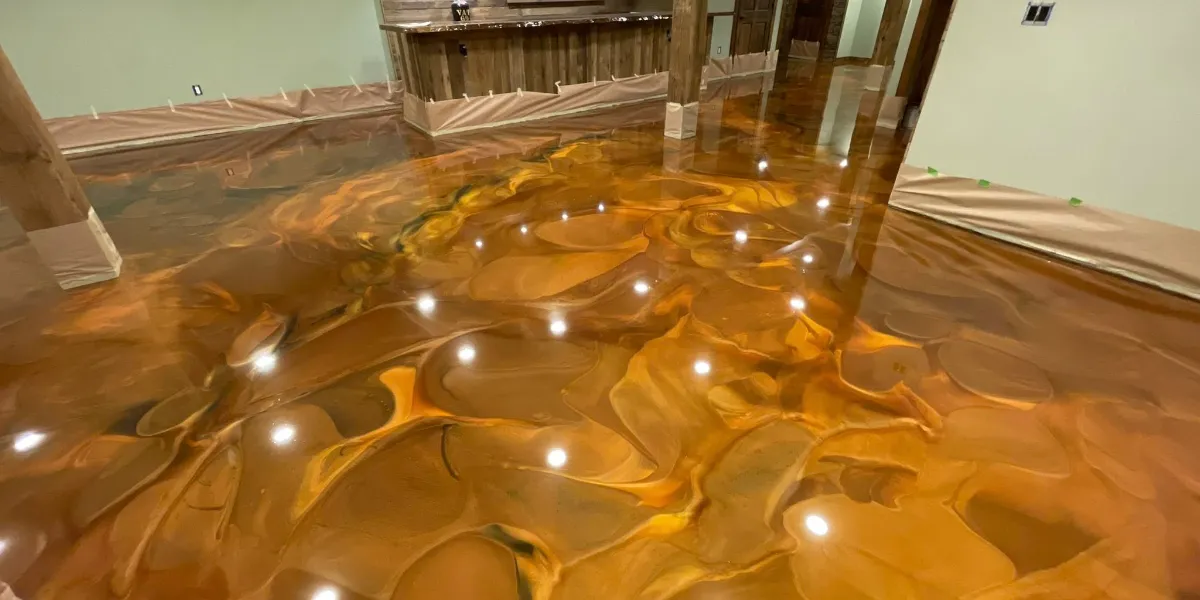
For customers who want something more custom inside the home, metallic epoxy floors may be another option. These are often used in interior spaces where appearance is a major part of the project.
What spaces commonly receive epoxy flooring after tile or vinyl removal?
We frequently see old flooring removed before installing coating systems in areas such as:
-
- Basements
- Laundry rooms
- Utility rooms
- Commercial kitchens
- Retail spaces
- Workshops
- Storage areas
In homes, the most common projects are basements, laundry rooms, mudrooms, and garage-adjacent spaces. These are areas where moisture, dirt, and daily traffic can wear down traditional flooring.
In businesses, old vinyl tile is often removed before installing coatings designed for cleaning, durability, and safety. Restaurants, shops, offices, service bays, and back-of-house areas all have different needs, so the coating system should match the way the space is actually used.
For outdoor concrete, such as patios and pool areas, the system changes again. That is why That Epoxy Guy offers dedicated patio floor coatings and pool deck coating options rather than using the same approach in every setting.
How much does it cost to epoxy over tile or vinyl?
The cost depends on whether the existing flooring can stay in place or needs to be removed.
Factors that affect project cost include:
-
- Type of flooring being evaluated
- Amount of demolition required
- Condition of the substrate below
- Repair requirements
- Coating system selected
A small, stable ceramic tile floor may require a different approach than a basement with old vinyl, failing adhesive, and moisture coming through the slab.
The most accurate way to understand cost is to schedule an on-site evaluation. You can also review That Epoxy Guy’s epoxy flooring cost guide for general pricing ranges and the main factors that affect concrete coating costs in Northeast Ohio.
When does epoxying over tile or vinyl make sense?
In our experience, coating over existing flooring may make sense when:
-
- The flooring is fully bonded and stable
- No moisture issues are present
- The substrate underneath is sound
- The floor can be properly prepared
Even then, it should not be assumed. The floor needs to be evaluated by someone who understands coatings, surface preparation, moisture, and substrate failure.
For many homeowners, the better long-term solution is to remove the old flooring and install the coating over properly prepared concrete. This is especially true for basements, interior concrete floors, and commercial spaces where durability matters.
If you are unsure, look through That Epoxy Guy’s before and after photos to see how much difference proper preparation and the right coating system can make.
Serving homeowners throughout Northeast Ohio
We install epoxy flooring and concrete coating systems throughout:
We also install garage floor coatings, basement epoxy floors, interior floor coatings, patio coatings, flake floor systems, metallic epoxy floors, and commercial concrete coating systems throughout surrounding Northeast Ohio communities.
So, can you epoxy over tile or vinyl flooring?
Sometimes, yes. However, the answer depends entirely on the condition of the existing flooring and the substrate below it. Some well-bonded tile surfaces may be suitable candidates, but many vinyl floors, damaged tile floors, and older flooring systems are better removed before coating installation. The success of any epoxy floor depends on proper evaluation, mechanical preparation, substrate stability, moisture conditions, and choosing the right coating system for the space.
If you're considering epoxy flooring over tile or vinyl, contact That Epoxy Guy for a free estimate. We'll evaluate your existing flooring, identify any hidden issues, and recommend the best long-term solution for your home, basement, garage, or commercial space.